


Pre-Ordering Hostas: How It Works, When We Ship and What to Expect
Order and pay now, and your bare-root hostas ship from 1 March. Here is how pre-ordering works and what to expect when your plants arrive.
3 min read

New varieties are the hostas we have added to our range for the coming season. Among them are hostas bred in the Netherlands and proven garden plants that are simply new to our range, such as Brother Stefan, Hosta of the Year 2017.
New varieties
Come here for something different: leaves that unfold almost white and turn light yellow in Lemon Feathers, curly, twisted leaves in Wheee!, shiny yellow leaves on red stems in Funky Monkey, and a giant, white-edged sport of Sum and Substance in Winter Snow.
The rest of the selection covers every colour and size, from the small, thick-leaved Hands Up to large blue-and-white hostas such as Barbara Ann. Several are tetraploids, with thicker leaves than the varieties they come from.
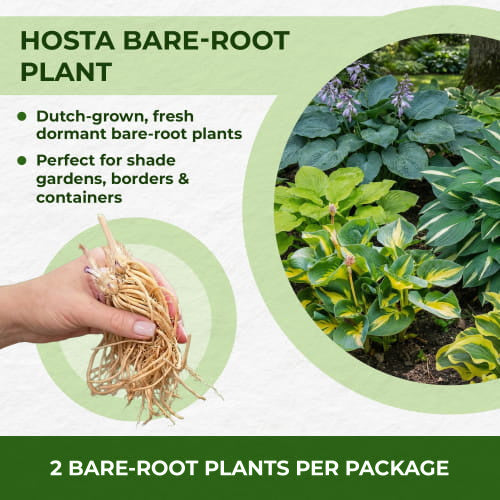
You can order new varieties all year round. Like all our hostas, they ship from 1 March to 1 July, and every pack contains 2 plants of the same variety with our 100% growing guarantee.
Most new hostas start in one of two ways. A sport is a natural mutation: one shoot on an existing plant comes up with a different colour, pattern or leaf shape, and the grower propagates it. Winter Snow began this way. A seedling grows from a cross between two parents and can combine the best of both. Either way, it takes years of selection and propagation before a new hosta reaches gardens.
Tissue culture, the laboratory propagation used for many modern hostas, speeds this up and sometimes produces new sports by itself: First Frost, for example, was found in tissue culture of Halcyon. Breeders can then register the name with the American Hosta Society, the official international registrar for hostas, so that each variety keeps one name all over the world.
Some newcomers are tetraploids, plants with a double set of chromosomes. In hostas this usually shows as thicker, tougher leaves, deeper colour and better slug resistance, though tetraploids can grow a little more slowly. Forbidden Fruit is a tetraploid form of Orange Marmalade, and Sweet Innocence one of Fragrant Bouquet.
Several of our new varieties were bred in the Netherlands. Look for Golden Spear, with spear-shaped, creamy white-centred leaves, the large, wavy Battle Strokes, Heatwave Harmony and Silver Feather, whose leaves emerge white in spring, as well as Lemon Feathers. Most of them show white or cream in their leaves, at least in spring, so they look best in light shade, out of hot afternoon sun.
Treat a newcomer like any other hosta: check its size, light and spacing on the product page, where the At a glance list sums up colour, size, light and best use in one place. For an easy start, pick a look you already like. Snow Cap pairs blue-green leaves with a white edge, Climax combines blue-green leaves with a yellow edge, and Tea at Bettys brings fragrant flowers in a compact size. If you collect hostas, the white-centred and twisted newcomers, such as Golden Spear and Wheee!, stand out most.
New varieties need the same care as any hosta: shade or partial shade, humus-rich soil that stays moist and protection for the young shoots in spring. White-centred newcomers such as Golden Spear, Heatwave Harmony and Vulcan prefer a sheltered spot out of afternoon sun, and tetraploids reward a little patience.
Yes. Every pack, new or classic, contains 2 plants of the same variety and comes with our 100% growing guarantee. If a plant does not grow although you followed our planting and care instructions, we replace it or refund the price.
Together with all our other hostas, from 1 March to 1 July. You can order at any time: orders placed between 1 July and 1 March ship from 1 March.
Young hostas often do. A plant in its first year has smaller leaves than a mature clump, and colour and pattern can shift with light and soil. Most varieties show their true character from the second or third summer.
Order and pay now, and your bare-root hostas ship from 1 March. Here is how pre-ordering works and what to expect when your plants arrive.
3 min read

Bare-root or potted hostas? An honest comparison of price, choice, timing and how well each grows, so you can pick the right one for your garden.
4 min read

Problems & pests
Crisp brown edges on hosta leaves are usually scorch: the leaf loses water faster than the roots can supply it, because of dry soil, hot afternoon sun, wind or competing roots. Check the soil moisture and the light first. If the brown streaks stop at the veins, or the stems collapse at the base, look for foliar nematodes or crown rot instead.
4 min read