What to plant with hostas: companion plants for shade
Quick answer
Plant hostas with shade lovers that differ in leaf or season: spring bulbs that flower before hostas wake, fine-leaved ferns and grasses, and summer flowers such as astilbe, Solomon's seal or foam flower. Match each partner's needs for moisture and shade to the spot, and give the hosta enough room to reach full size.
On this page
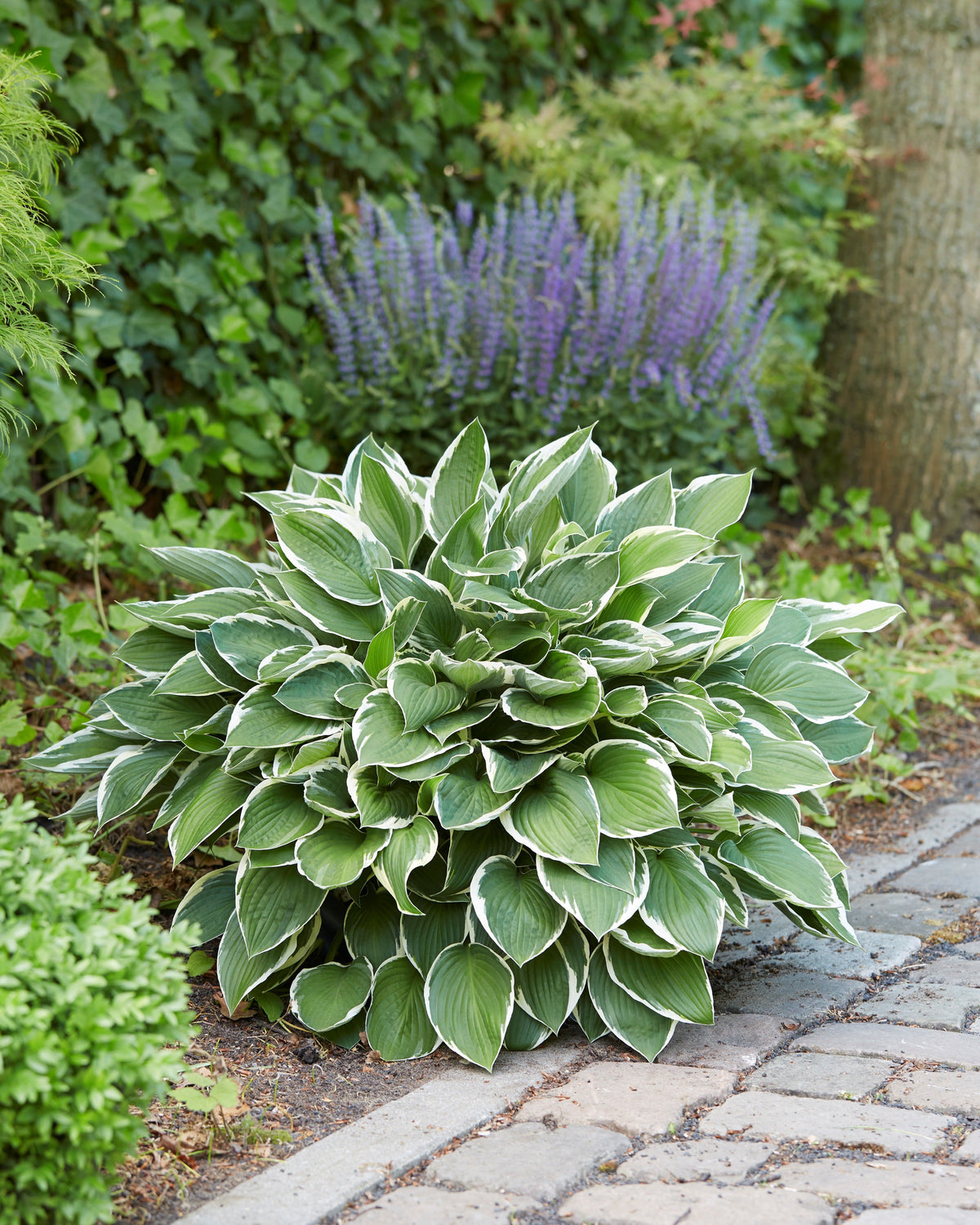
A bed of nothing but hostas can look heavy by midsummer and empty in early spring, when their shoots have barely broken the surface. The right neighbours solve both problems. Here are the partners that suit hostas best, why they work and how to choose them for your own patch of shade.
What makes a good companion for a hosta?
A good partner wants the same conditions and offers something the hosta lacks. In practice that comes down to four points:
- The same soil and light. Hostas grow best in moist, humus-rich soil in partial or full shade, so their neighbours should enjoy that too. A plant that wants dry, sunny ground will sulk beside them.
- A different leaf. Hosta leaves are broad and solid. Fine, feathery or grassy foliage beside them makes both plants easier to read, which is why Iowa State University recommends astilbe, goat's beard and ferns as partners.
- A different season. Hostas stay underground until mid-spring, the RHS says. Plants that flower in late winter and early spring fill that gap, and the hosta's spreading leaves later cover partners that fade early.
- Matching vigour. A fast spreader can swamp a small hosta, and a giant hosta can smother a low neighbour. Pair plants of similar strength, or leave space between them.
Spring bulbs: colour before the hostas wake
Bulbs and hostas take turns, which is why they make such an easy pair. The bulbs flower while the hosta is still dormant; by the time their own leaves turn yellow and untidy, the hosta has opened above them and hides the fading foliage. Iowa State lists tulips, daffodils, hyacinths, snowdrops, squill, grape hyacinths and ornamental onions as good choices.
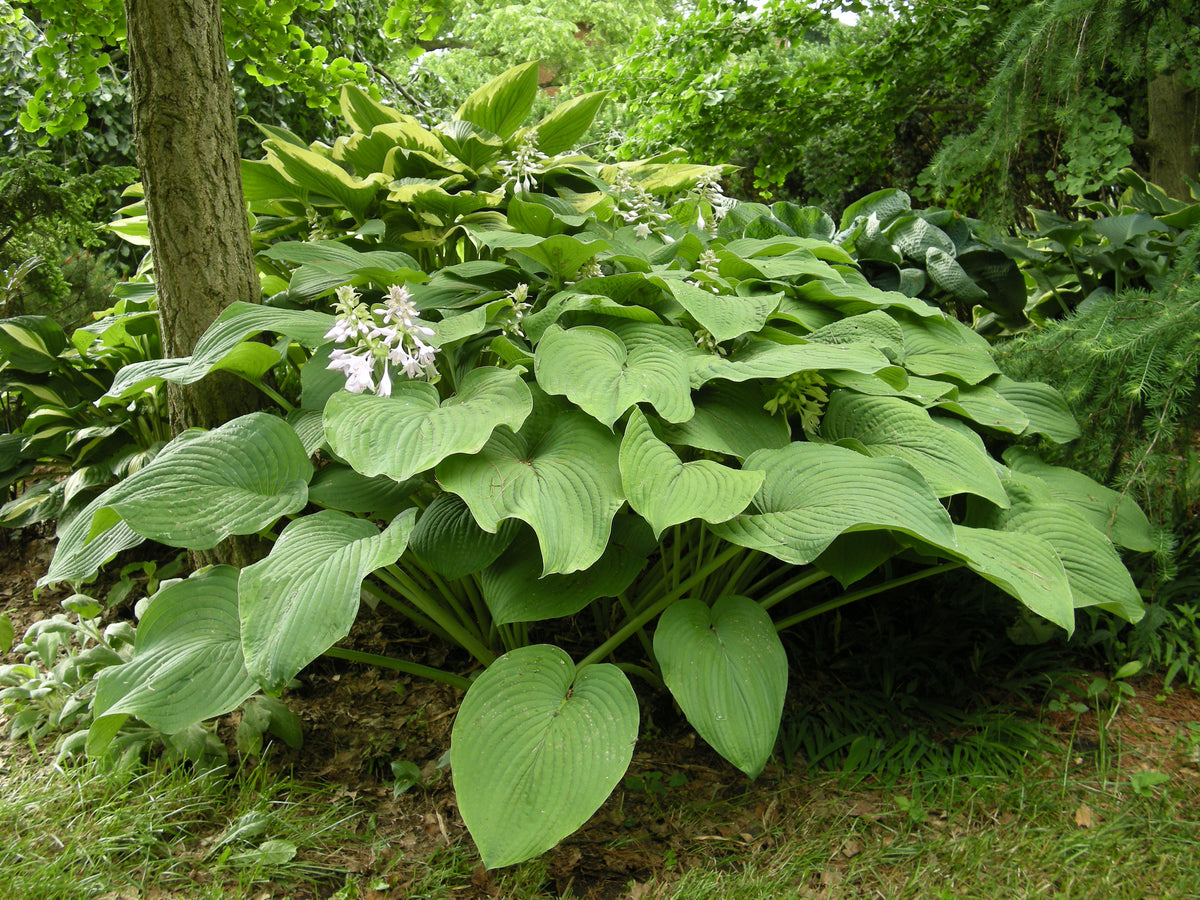
In shade, start with snowdrops. The RHS calls them some of the first plants to flower in the new year and says they do best in partial shade around deciduous trees and shrubs, which is often exactly where hostas grow. Small daffodils and crocuses are useful around young giant hostas too, which need several years to fill the space they will eventually take.
Ferns and grasses for fine texture
Ferns like the same cool, moist shade as hostas, and their divided fronds are the best possible contrast to a broad, plain leaf. Two that look good beside hostas:
- Japanese painted fern (Athyrium niponicum var. pictum): grey fronds with a red-purple zone along the centre. It needs moist soil and a sheltered, shady spot.
- Copper shield fern (Dryopteris erythrosora): young fronds often unfold coppery pink. The RHS says it tolerates dry shade once it has been watered regularly through its first season.
There is more on pairing the two in our guide to hostas and ferns.
Japanese forest grass, Hakonechloa macra, brings a similar fineness in a different shape: a soft mound of arching, bright green leaves that turn red-brown in autumn and stay into winter. The RHS rates it for sun as well as shade, so it bridges the gap between a shady bed and a brighter edge.
Summer flowers for shade
Most hostas are grown for their leaves, so flowering partners bring the colour. These four are at home in shade:
- Astilbe. Feathery plumes of flowers; 'Fanal' flowers deep red in early summer. It needs soil that never dries out: the RHS describes it as drought intolerant and warns that hot sun can damage it.
- Solomon's seal (Polygonatum × hybridum). Arching stems 1–1.5 m tall, hung with creamy-white, green-tipped flowers in late spring. It accepts full shade.
- Bleeding heart (Lamprocapnos spectabilis). Heart-shaped flowers in rose-red, purple-pink or white in late spring and early summer. Walters Gardens notes that it dies down after spring, and a hosta beside it fills the space it leaves.
- Foam flower (Tiarella cordifolia). Low, with spikes of creamy-white flowers, and it spreads freely between larger plants. Walters Gardens singles it out as a partner for hostas and ferns.

Low plants for the front of the bed
- Siberian bugloss (Brunnera macrophylla 'Jack Frost'). Large, heart-shaped silver leaves veined in green, and small blue flowers in spring. It prefers a cool, shady spot, just like a hosta, and spreads to 0.5–1 m.
- Barrenwort (Epimedium). Walters Gardens counts it among the few plants that survive dry shade, though it is slow to establish. The form 'Sulphureum' has primrose-yellow flowers, and the RHS says it tolerates slightly drier soil.
- Lady's mantle (Alchemilla mollis). Velvety, scalloped leaves that hold raindrops like beads, and sprays of small yellow flowers from summer into autumn. It self-seeds freely, so remove the faded flowers before seed forms.
- Heuchera. Grown for coloured leaves: 'Palace Purple' is evergreen, with metallic bronze-purple foliage and pale pink flowers in early summer. Walters Gardens says heucheras blend easily with most other perennials.
Companions at a glance
Heights are the RHS ranges for a mature plant; hardiness is the RHS rating, where H7 is the toughest and survives below −20 °C.
| Plant | Why it works with hostas | Height | Hardiness |
|---|---|---|---|
| Snowdrop | flowers early in the year, before hostas appear | 0.1–0.5 m | H5 (−15 to −10 °C) |
| Japanese painted fern | fine grey fronds for moist shade | 0.1–0.5 m | H5 (−15 to −10 °C) |
| Copper shield fern | coppery young fronds; copes with dry shade once settled | 0.5–1 m | H4 (−10 to −5 °C) |
| Japanese forest grass | arching grass for a brighter edge | 0.1–0.5 m | H7 |
| Astilbe 'Fanal' | red plumes in early summer; needs moist soil | 0.5–1 m | H7 |
| Solomon's seal | tall arching stems, late-spring flowers | 1–1.5 m | H7 |
| Bleeding heart | spring flowers; the hosta fills its gap later | 0.5–1 m | H6 (−20 to −15 °C) |
| Foam flower | creamy spikes, spreads between hostas | 0.1–0.5 m | H5 (−15 to −10 °C) |
| Siberian bugloss 'Jack Frost' | silver leaves, blue spring flowers | 0.1–0.5 m | H6 (−20 to −15 °C) |
| Barrenwort 'Sulphureum' | yellow flowers; slightly drier soil | 0.1–0.5 m | H7 |
| Lady's mantle | yellow flowers into autumn; sun or light shade | 0.1–0.5 m | H7 |
The copper shield fern, rated H4, is the least hardy plant in the list; all the others are rated to survive at least −10 °C.
Hostas with other hostas
Hostas are often their own best partners, provided each neighbour brings a clear contrast:
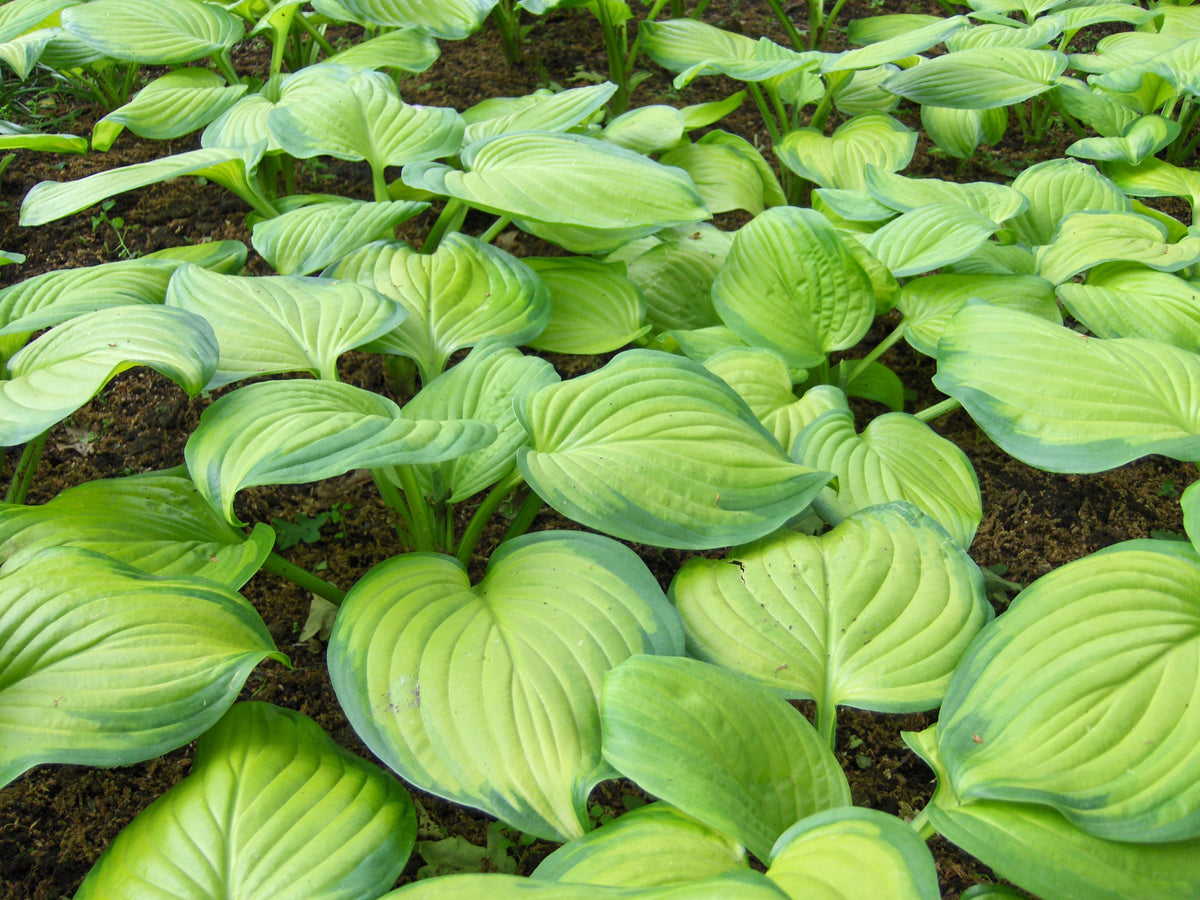
- Blue beside yellow. Halcyon is blue and Sunny Halcyon, a yellow sport of it, has the same pointed leaf, so all you notice is the colour. Our blue hostas and yellow and gold hostas offer plenty of other pairs.
- White rims beside plain dark green. The broad white edges of Patriot look sharper next to the solid, glossy leaves of Devon Green. See our white and cream hostas and green hostas for more.
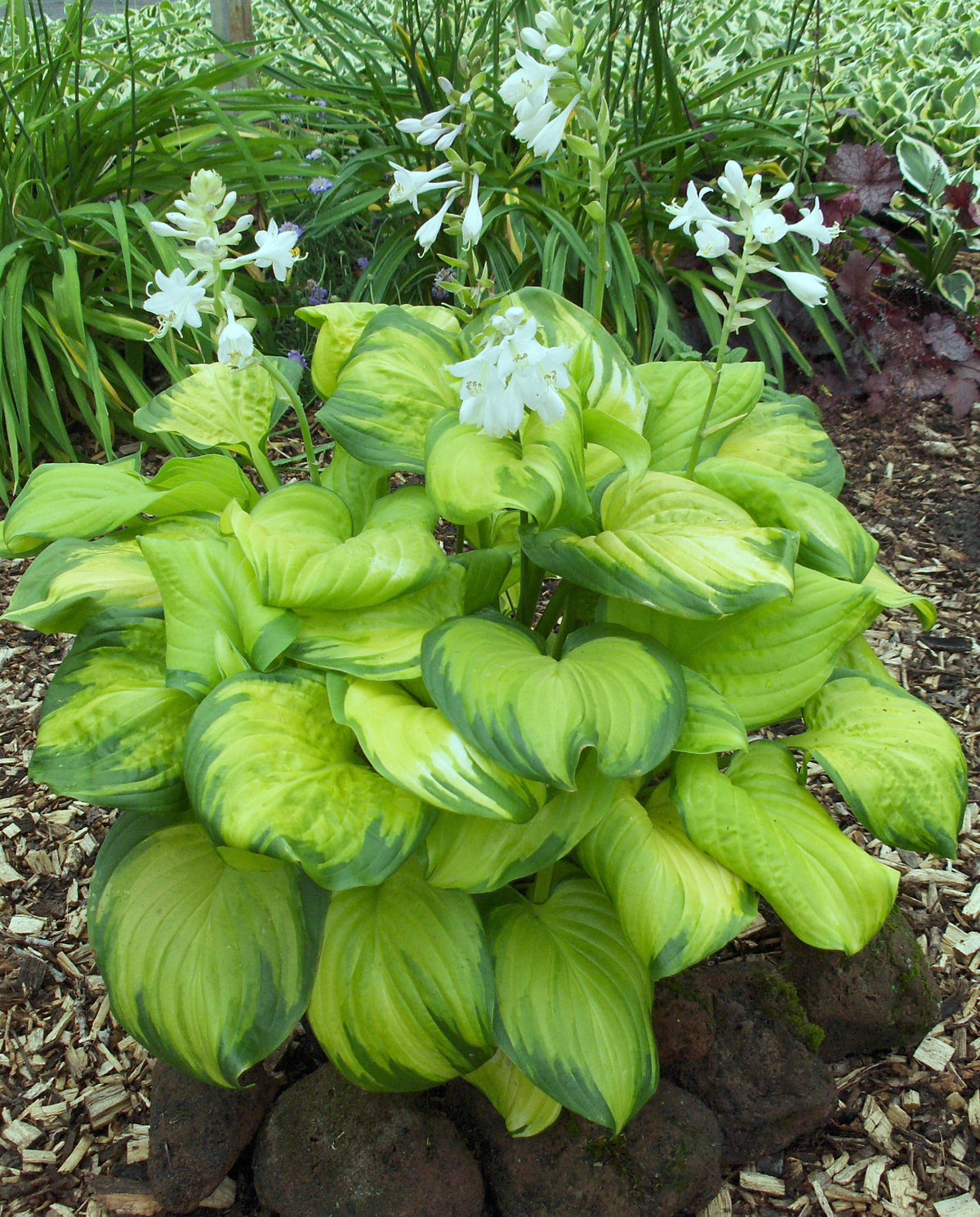
- A gold centre beside blue. Stained Glass, with yellow centres and dark green margins, glows against a blue hosta such as Halcyon; both are medium-sized, so neither will dwarf the other. Our medium hostas give you the most combinations of this kind.
- One pattern, repeated. Put three patterned hostas together and none of them stands out. Pick one of our variegated hostas, repeat it along the bed and surround it with plain leaves.


For a bolder scheme, a large, cream-centred hosta such as American Sweetheart looks fresh against the red and pink of astilbes, as the photo with the summer flowers shows.
Choosing companions for your kind of shade
Shade comes in degrees, and the RHS definitions help. Partial shade means three to six hours of direct sun at midsummer, moderate shade two or three hours, and deep shade less than two.
- Moist, partial shade suits almost everything in the table above, astilbe and bleeding heart included.
- Deep shade shortens the list. Solomon's seal, the ferns, foam flower and Siberian bugloss all accept full shade, and plain green or blue hostas manage with less light than gold ones.
- Dry shade under trees rules out astilbe. Barrenwort and the copper shield fern are better bets, and the fern still needs regular watering in its first season. Our guide to hostas under trees deals with this difficult spot.
- A brighter edge with some morning sun suits Japanese forest grass and lady's mantle, and also yellow hostas, which colour best with about four to six hours of sun, according to Iowa State.
Whatever you choose, prepare the soil for companions as you would for the hostas, with plenty of compost dug in; our planting and care guide explains how.
Spacing a mixed planting
Place the hostas first, at the distance they will need when mature: about 30 cm apart for small varieties, 50 cm for medium ones and 75–100 cm for large and giant ones. Then fit the companions into the space left over, allowing for their own spread: Siberian bugloss and the copper shield fern can each reach 0.5–1 m across. A plan for a whole border is in our guide to shade border ideas.
Young hostas leave gaps for the first year or two. Fill them with bulbs or a few ferns rather than with fast spreaders such as ostrich fern, which Walters Gardens says spreads quickly by underground runners and needs a lot of room. Low ground cover between hostas is a subject of its own, covered in our guide to hostas as ground cover.

Common mistakes
- Planting astilbe or other thirsty plants in the dry shade under trees.
- Letting a fast spreader such as ostrich fern loose among small hostas.
- Putting tall companions in front of low hostas, so the hosta leaves disappear.
- Combining so many patterned hostas that none of them stands out.
- Forgetting where the dormant hostas are and planting bulbs or perennials on top of their crowns.
In short
- Check your shade and soil first, then choose companions that want the same.
- Set the broad hosta leaf against fine ferns, grasses or feathery astilbe.
- Plant snowdrops and other spring bulbs to flower before the hostas appear.
- Give hostas their full spacing and fill young gaps with bulbs or ferns, not spreaders.
- Repeat a few hosta varieties with clear contrasts instead of mixing many patterns.
Questions & answers
Which hosta companions are harmful if eaten?
The RHS lists bleeding heart, snowdrops and Solomon's seal as harmful if eaten, and notes that Solomon's seal is toxic to dogs and that bleeding heart leaves can irritate the skin. Wear gloves when handling them, and think about where you plant them if young children or pets use the garden.
Which hosta companions also take some sun?
Japanese forest grass grows in sun or shade, lady's mantle does well in sun or light shade, and the RHS says barrenwort 'Sulphureum' tolerates full sun. For the hostas in such a spot, choose sun-tolerant varieties and keep the soil moist.
Which companions spread beyond their space?
Foam flower spreads freely, and ostrich fern runs quickly underground, so give both plenty of room or a corner of their own. Lady's mantle stays put but seeds itself around unless you remove the faded flowers before seed forms.
How long until a mixed hosta bed looks full?
Plan on about three years. Most hostas have settled in by their second or third summer, and the RHS gives many companions, from Japanese forest grass to Siberian bugloss and foam flower, two to five years to reach their final size.