Dividing hostas: when and how to split a clump
Quick answer
Divide a hosta in early spring, when the pointed shoots are just breaking through, or in late summer as a second choice. Lift the whole clump, cut it with a sharp spade or knife into pieces that each have roots and one to three healthy buds, replant them at the same depth straight away and water well.
On this page
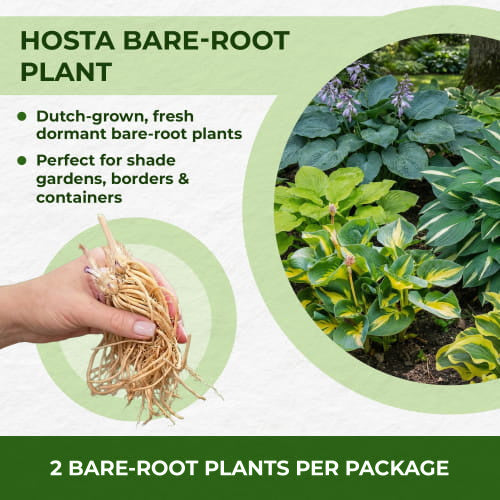
Dividing is the easiest way to get more hostas and to refresh a clump that has grown crowded. It is also how the plants in our parcels began: every division we send started life as part of a mature clump, dug up in the field and split by the grower. Below you will find when to divide, how to do it and how to care for the pieces afterwards.
When should you divide hostas?
For most gardens, early spring, just as the new shoots appear. Iowa State University calls spring the best season and suggests digging when the shoots look like pointed bullets, and University of Missouri Extension also recommends early spring, as the shoots come through. At that stage you can see exactly where the buds are, and there are no open leaves to tear.
Late summer is the second window. Iowa State says hostas can be divided at any time from spring to late summer, and the RHS gives late summer or early spring for Halcyon. Pieces divided late in the season have less time to root before winter, so cover them with a thick layer of straw in late autumn; Iowa State recommends this to stop repeated freezing and thawing from pushing them out of the ground.
The sources do not agree completely:
| Source | When to divide | How often | Buds per piece |
|---|---|---|---|
| RHS hosta guide | autumn or early spring | every 4–5 years | 1–3 |
| RHS advice on dividing perennials | spring or late autumn | not given for hostas | five or six for big clumps |
| Iowa State University | spring is best, possible until late summer | every 5–7 years | at least 2–3 |
| University of Missouri Extension | early spring, as shoots emerge | not given | not given |
| BBC Gardeners' World | spring | every 3–5 years | one or more |
Part of the difference is climate. British advice assumes a mild autumn, while Iowa State writes for hard winters in which autumn divisions can be lifted out of frozen ground. The RHS adds a condition of its own: divide only when the soil is dry enough to work, and in a wet autumn wait until spring. Across most of northern and central Europe we recommend early spring, which is also the time our planting guide gives.
Does your hosta need dividing?
Not necessarily. A healthy hosta with room to spread can stay in the same spot for many years, and University of Missouri Extension points out that most varieties need about five years without disturbance to form a full clump. Divide when there is a reason:
- you want more plants of a variety you already have;
- the clump has outgrown its space or is pressing against its neighbours;
- the middle has died out and the shoots form a ring, in which case Iowa State suggests throwing the dead centre away;
- the clump has become crowded, the point at which our care notes for varieties such as Robert Frost suggest lifting it.
Leave young plants alone. A division planted this year spends its first seasons making roots, as our guide to a hosta's first year explains.
What you need
- A sharp spade. For very large clumps with tough, fibrous roots, the RHS also suggests two garden forks pushed in back to back and levered apart.
- A sharp knife for the smaller cuts; the RHS says an old kitchen knife does the job.
- Household bleach to clean your tools. The American Hosta Society recommends a 10% bleach solution, which is roughly one part bleach to nine parts water.
- A bucket of water or a damp sack to keep the pieces from drying out while you work, and compost if you want to pot some of them up.
How to divide a hosta, step by step
- Lift the clump. Loosen the soil all round with a fork, working outwards from the crown as the RHS describes, then lift the whole plant.
- Look before you cut. Knock off the loose soil so that you can see where the shoots join the crown, and plan your cuts between them.
- Cut. Slice through the crown with the spade or knife into pieces, each with its own share of roots and healthy buds. A big clump can be halved with one firm push of the spade and then cut again.
- Tidy up. Throw away rotten or broken pieces, and the old dead centre if there is one.
- Replant straight away. Set each piece at the depth it grew before, with the shoots just showing above the soil, and firm it in.
- Water thoroughly, and keep the soil moist while the pieces settle in.

How big should each piece be?
That depends on how soon you want a full-looking plant. The RHS hosta guide asks for 1–3 good buds per piece, Iowa State for at least 2–3 shoots, and the RHS advice on dividing perennials goes much bigger, splitting large hosta clumps into sections of five or six shoots.
| Piece | What it gives you |
|---|---|
| a single bud | the most new plants, but each one has the furthest to go |
| 2–3 buds | a fair balance between the number of plants and the time they take |
| five or six shoots | a ready-made small clump, but only a few new plants |
The variety matters as well. Hostas with a lot of white or cream in the leaf make new buds more slowly than plain green ones, according to the Hosta Helper, a site sponsored by the American Hosta Society, so cut them into fewer, larger pieces. Miniatures naturally give smaller pieces than giants.

Replanting or potting the divisions
- Back in the ground. Dig compost into each new spot, as you would for any new hosta, and give each piece the room its variety will need: about 30 cm for a small hosta, 50 cm for a medium one and 75–100 cm for a large or giant one. Our planting and care guide covers soil and depth.
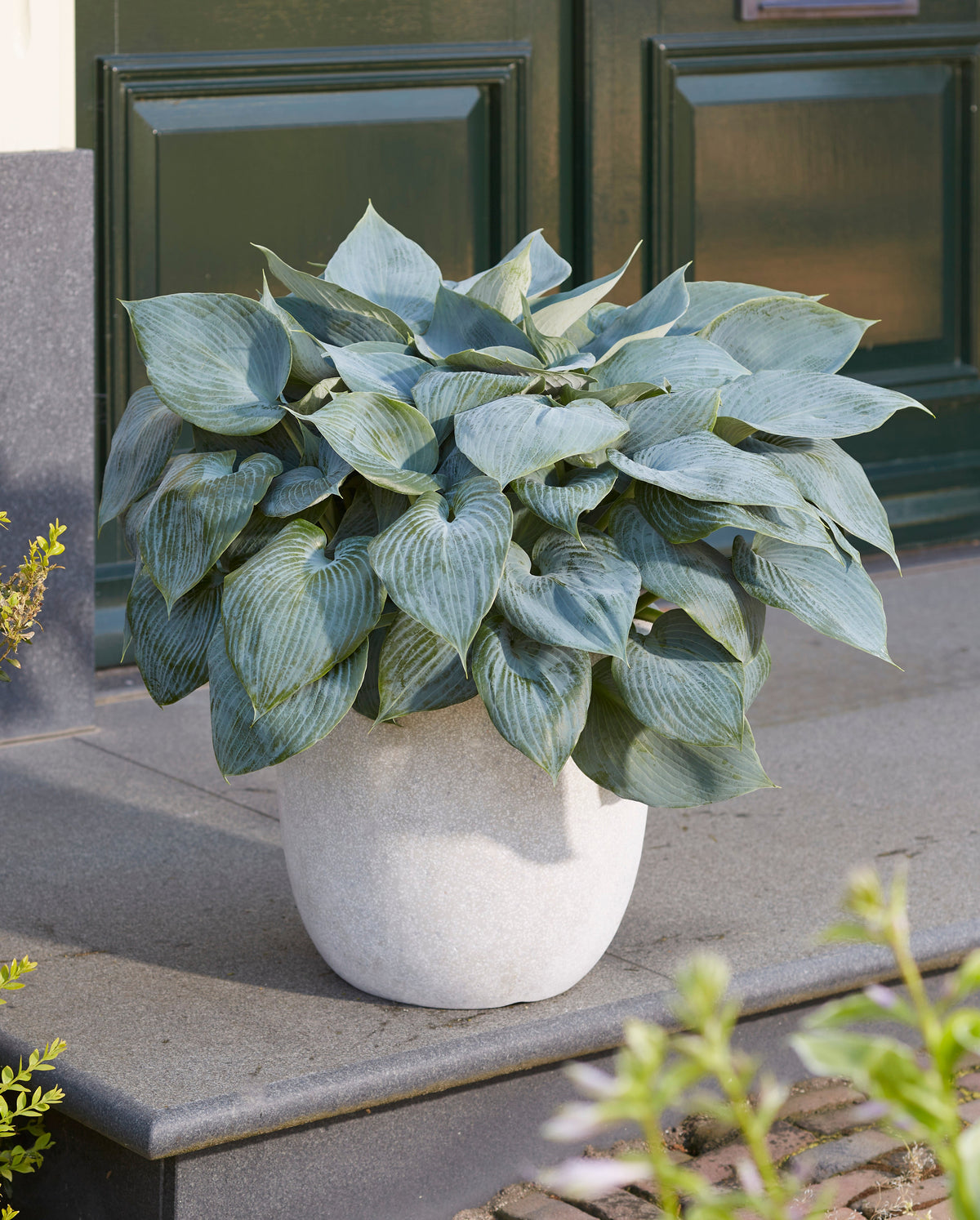
- Into pots for a while. BBC Gardeners' World grows divisions on in 30 cm pots, using peat-free multipurpose compost mixed with an equal volume of fine grit, in a sheltered spot until they are ready to plant out. The RHS also mentions potting up divisions and keeping them somewhere frost-free over winter. For hostas that will stay in containers, see our guide to growing hostas in pots.

Aftercare for new divisions
Treat every piece like a newly planted hosta. Keep the soil moist through its first summer, spread a mulch around it and expect smaller leaves than the parent clump had, for a season or two. The RHS says divisions should flower from their second year. Late-summer pieces need their straw cover over winter, and all young divisions need checking for slugs while their spring shoots are soft.

Clean tools and Hosta Virus X
Dividing is also the moment when a virus can spread. The American Hosta Society explains that Hosta Virus X usually travels in sap from an infected plant into a wound on a healthy one, and that tools not cleaned between plants are one of the ways it gets there. So:
- dip the spade and knife in a 10% bleach solution before you start on the next plant;
- never divide or give away a plant you suspect is infected, and put it in the bin rather than on the compost heap;
- do not plant another hosta in that spot for at least three years.
Our guide to Hosta Virus X describes the symptoms to watch for.
Good clumps to divide
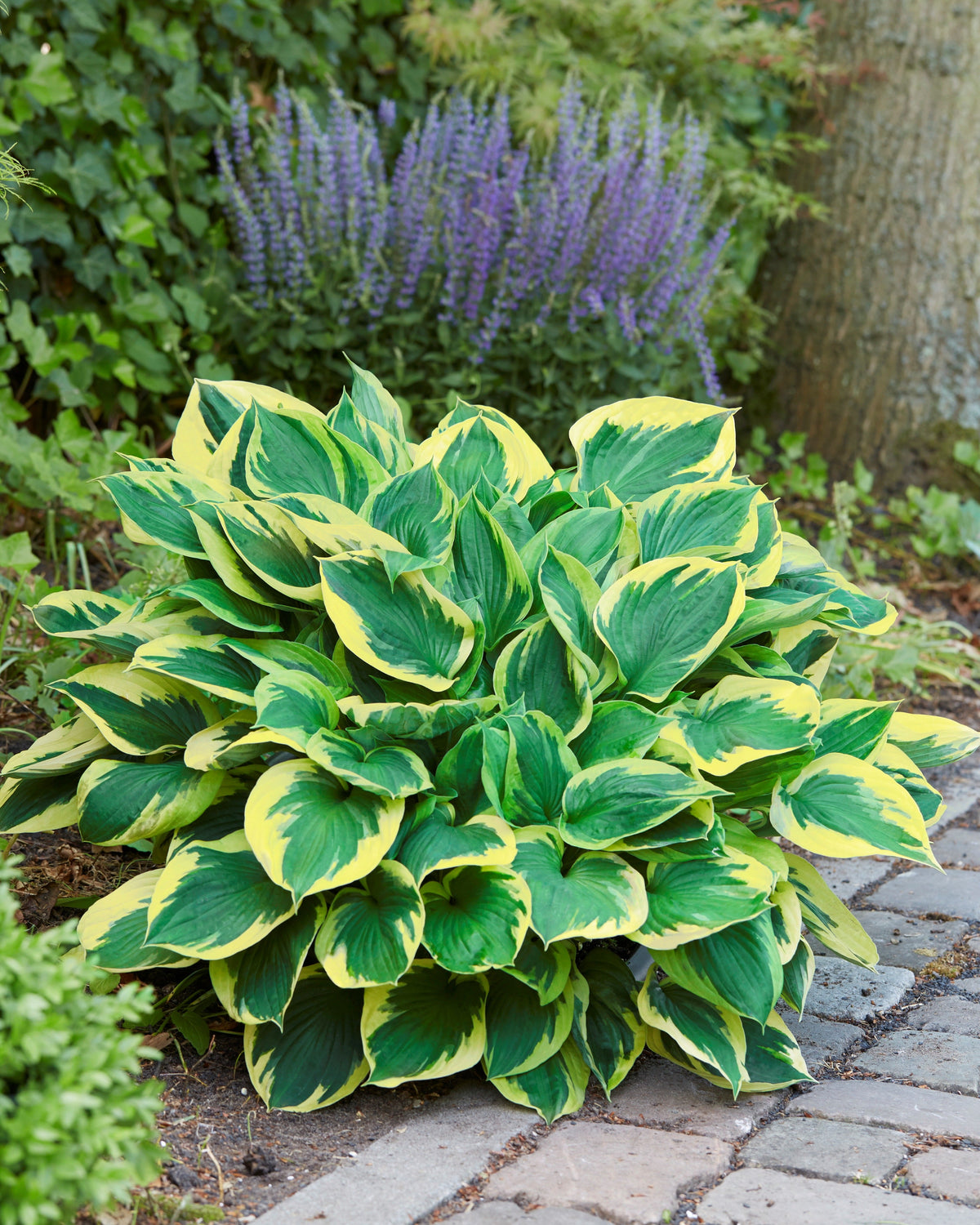
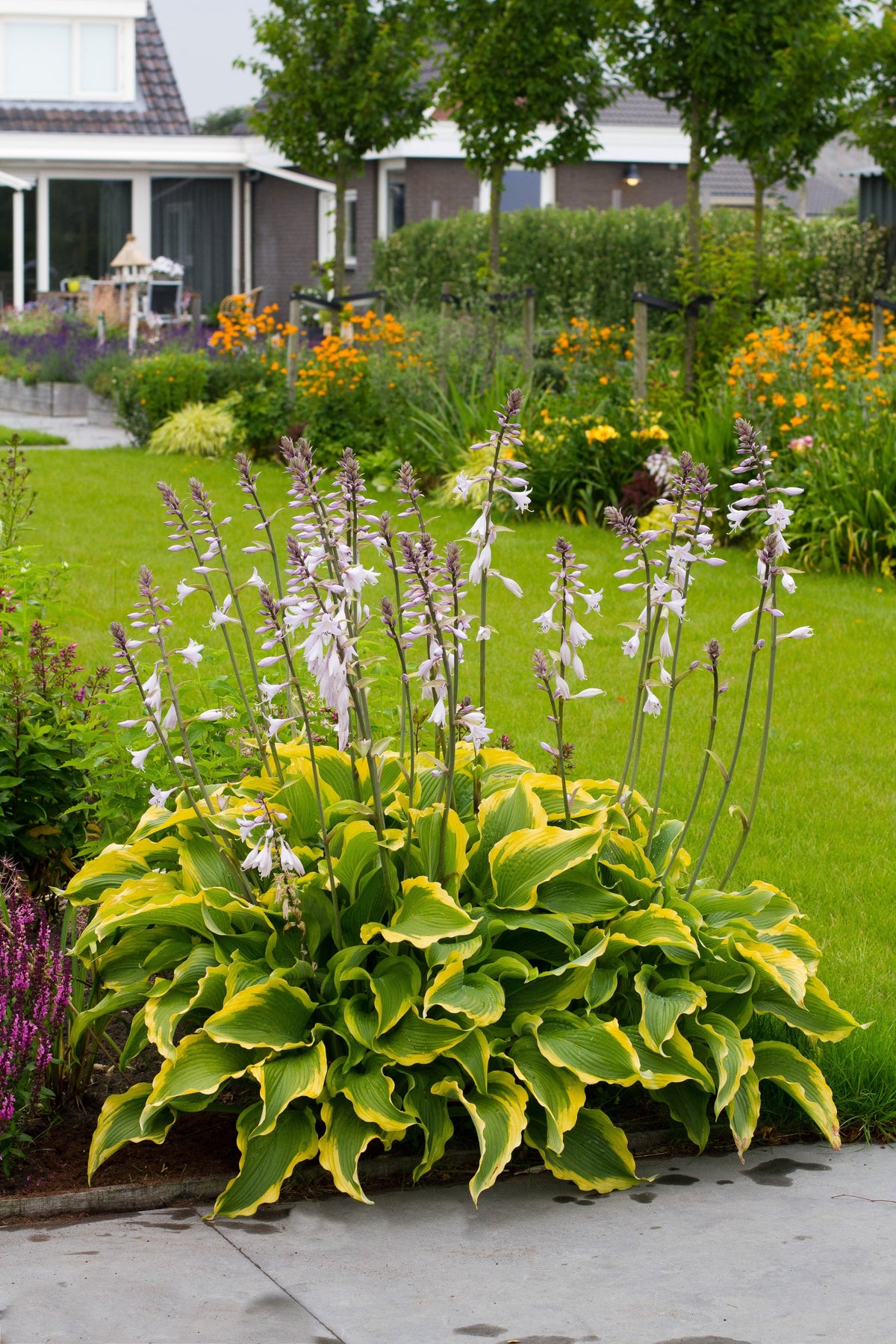
Large, vigorous clumps give the most pieces. Among our large and giant hostas, Atlantis has dark green leaves with a yellow edge, American Sweetheart cream centres with green margins, and Robert Frost blue-green leaves edged in white; the giant Regal Splendor was Hosta of the Year in 2003. All four carry the same advice in their care notes: split a big clump early in spring, once the shoots show.
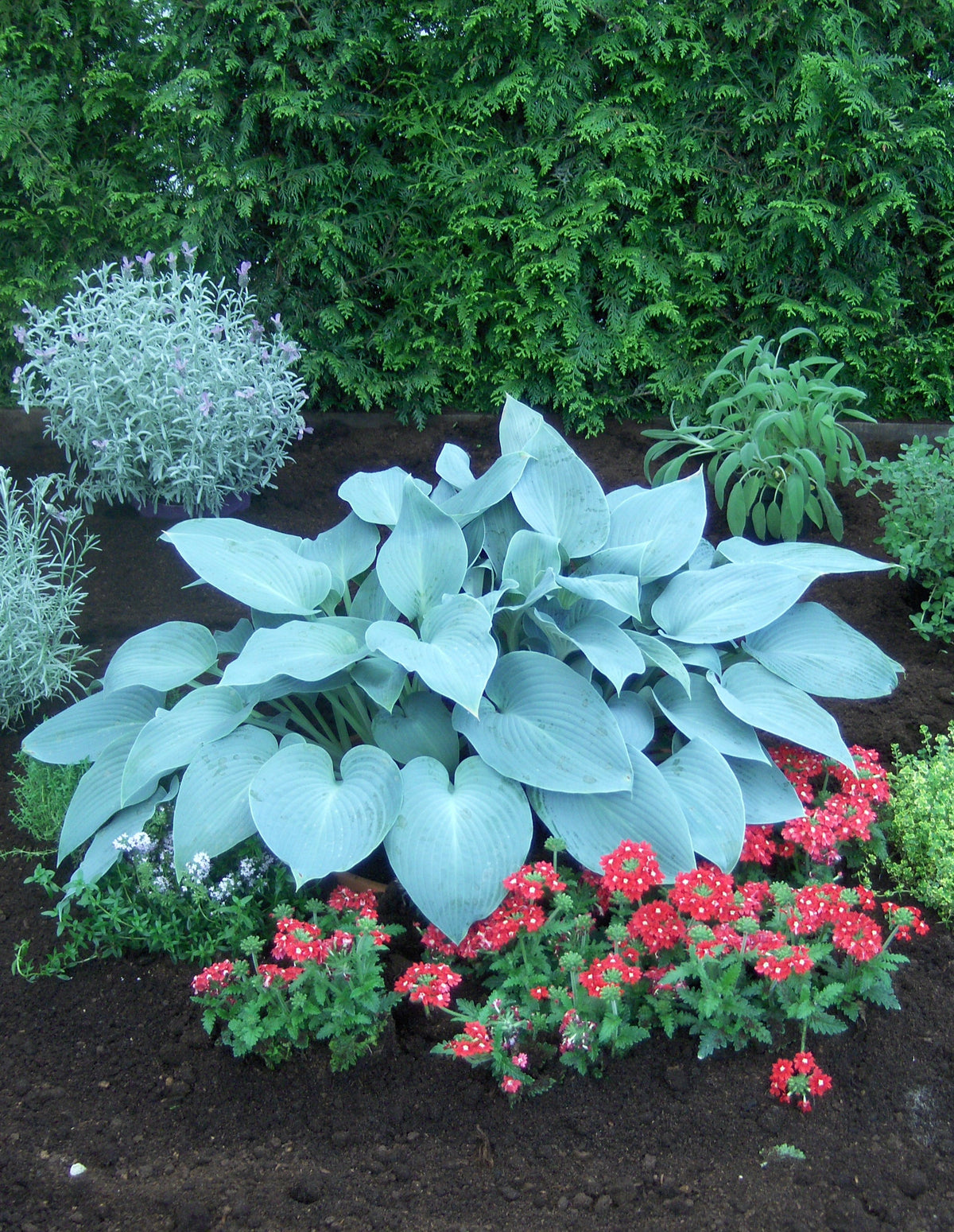
Among medium hostas, Halcyon, the 2026 Hosta of the Year, is a good example, and the RHS gives it its own timing: late summer or early spring. The other award winners we grow are in the Hosta of the Year collection, more blue varieties among our blue hostas, and every hosta we sell under all hostas.

Common mistakes
- Dividing a young hosta that has not yet formed a proper clump.
- Cutting pieces with no buds, or with buds but hardly any roots.
- Leaving the pieces lying in sun or wind while you finish the job.
- Replanting deeper than before, with the shoots buried.
- Going from plant to plant with the same uncleaned knife.
- Dividing late in a cold, wet autumn, when the pieces cannot root before winter.
In short
- Divide in early spring as the shoots appear, or in late summer as a second choice.
- Lift the whole clump and cut it into pieces with roots and at least one to three buds each.
- Clean your tools in bleach solution between plants.
- Replant at the old depth straight away and water well.
- Cover late-summer divisions with straw over winter and expect flowers from the second year.
Questions & answers
Can I divide a hosta in summer?
Yes, although it is not ideal. Iowa State says hostas can be divided at any time until late summer. In hot, dry weather the pieces need frequent watering until they have rooted, so spring is the easier choice.
Can I divide a hosta growing in a pot?
Yes. About every third year a potted hosta needs either splitting or a bigger pot, according to BBC Gardeners' World. Ease it out of the pot in early spring, slice the root ball into sections that each keep some buds and roots, and give each section its own pot of fresh compost.
Do I have to divide hostas at all?
No. A hosta that looks healthy and has room to grow can stay undivided for many years. Division is worth doing when you want more plants or when a clump is crowded or dying in the middle, not as a yearly job.
How soon can I divide the same hosta again?
Give the pieces time to grow back into clumps. The RHS suggests dividing every four to five years and Iowa State every five to seven, so a piece replanted this spring will usually be ready again in about five years.