Deer, rabbits and voles: how to protect hostas from animals
Quick answer
Hostas are not deer-proof: Rutgers University rates them in its highest damage category, and rabbits and voles eat them too. Thick-leaved varieties may be a little less tempting, but only a physical barrier reliably works: a fence, a cage or netting dug in against tunnelling animals. Identify the animal first, because deer, rabbits, slugs and voles leave different clues.
On this page
Gardeners who plant hostas to fill a shady bed soon find out that they are not the only ones who like them. Deer, rabbits, voles and slugs all eat hostas, and each leaves different clues. Below you will find how to tell them apart, how likely your hostas are to be eaten and what really protects them.
Are hostas deer resistant?
No. Rutgers University's deer-resistance ratings run from A (rarely damaged) to D (frequently severely damaged), and Rutgers places hosta in category D. It adds that how a plant fares depends on the local deer population and the weather, and a hungry deer will eat almost anything. Michigan State University Extension makes the wider point: even a hosta in the shelter of a suburban or urban garden is not safe from deer, rabbits, slugs and snails, or voles and mice. These ratings come from the United States, so ask neighbours which animals visit your own area.
Which animal is eating your hostas?
The pattern of damage tells you more than the amount of leaf that is missing.
| What you see | Likely culprit |
|---|---|
| Large parts of leaves gone overnight, ragged stems left behind | Deer |
| Clean-cut chew marks on leaves and stems; young spring shoots disappear | Rabbits. Michigan State University Extension describes clean-cut marks on leaves and stems, and rabbits favour young, tender leaves. |
| Irregular holes with slime trails | Slugs and snails (see slugs and snails on hostas) |
| A plant that wilts, collapses or comes loose, with roots eaten | Voles. The Missouri Botanical Garden shows hosta roots eaten away by voles. |
Most of these animals feed at night, so a look at dusk or dawn, or a small camera, often settles the question.
What really protects hostas?
A barrier. Sienna Hostas, a nursery that has won RHS Chelsea gold, says that the most effective way to protect hostas from deer is to physically block access to the garden. In practice:
- Fence the bed or the garden. Deer need a tall fence, and it only works if there are no gaps.
- Cage new shoots in spring. A wire cage or netting over the clump protects the soft young leaves that rabbits like best, and can come off once the leaves have hardened.
- Dig netting into the soil where animals tunnel under fences.
- Plant in a buried wire-mesh basket where voles are a problem, a trick many gardeners use to guard the roots.
- Raise or cage pots. Container plants are easier to protect than a border.
Repellent sprays and home remedies such as powders or strong smells are widely suggested, but we have not found trial evidence that they keep animals off, so treat them as an extra at most.

Are some hostas less tempting?
Some hostas are marketed as slightly deer resistant, but hungry deer will eat almost any plant. Thick, firm leaves are harder to chew, which is why slug-resistant varieties suffer less from slugs, and they may be a little less appealing to browsing animals too. Treat that as a bonus, not a guarantee. Good thick-leaved choices from our range:
- Big Daddy: extra large, with puckered blue leaves.
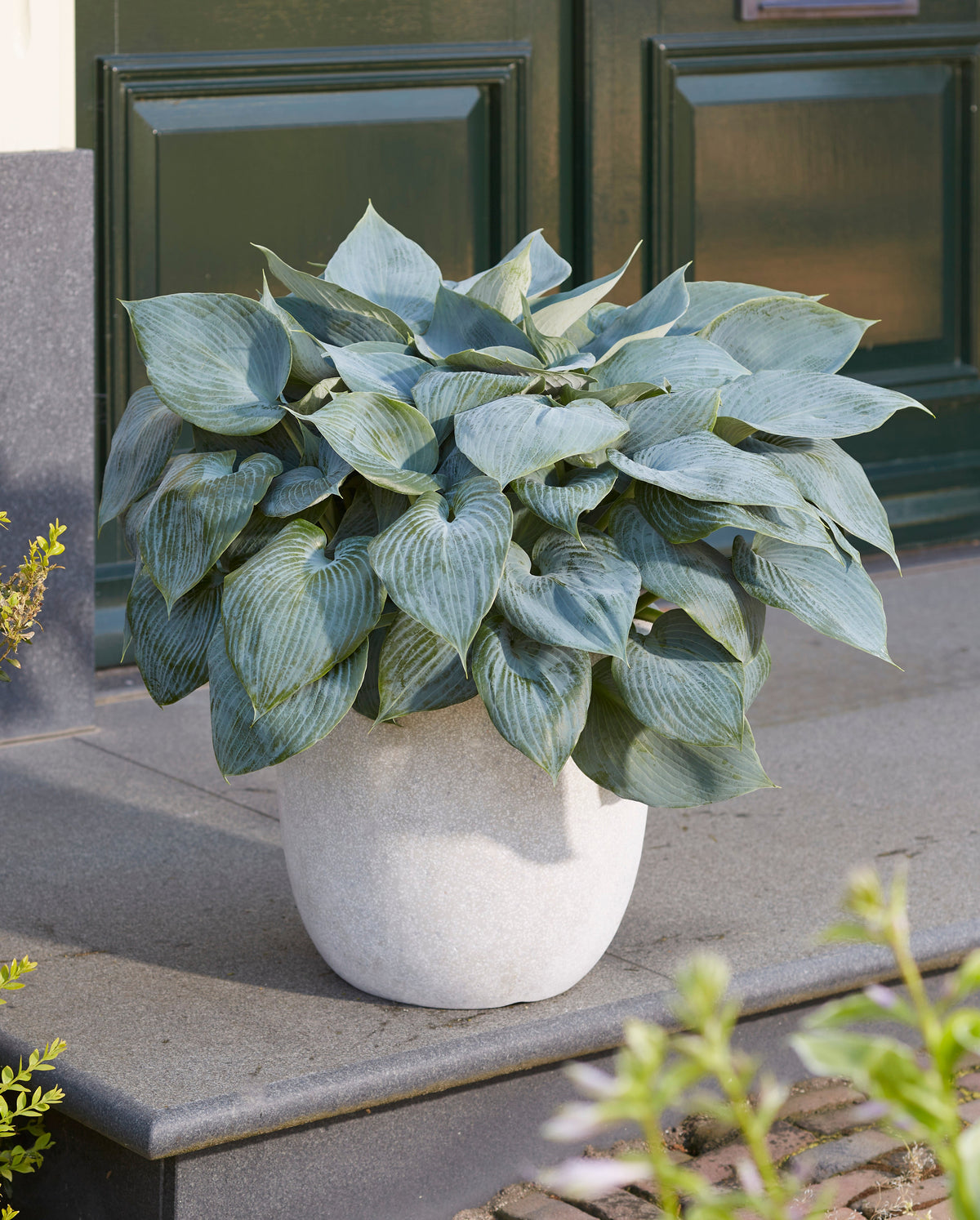
- Blue Angel: large, blue-green, slug resistant.
- Bullet Proof: a medium blue hosta, slug resistant.
See all our slug-resistant hostas.
Will a browsed hosta recover?
Usually. A hosta that has lost its leaves once will normally regrow, but a plant that is stripped again and again loses the energy it stores for next year. Trim any ragged stems, water in dry weather, and protect the plant from now on. Do not try to force regrowth with fertiliser (see feeding hostas). If young shoots vanish again and again each spring, suspect rabbits and cage them early.
Common mistakes
- Relying on a plant label that says deer resistant.
- Waiting until the plant has been stripped before protecting it.
- Fencing above ground only, where voles or rabbits tunnel underneath.
- Blaming deer for damage that slugs or voles caused.
In short
- Hostas are not deer proof: Rutgers rates them in its highest damage category.
- Work out the culprit from the damage: ragged stems (deer), clean cuts (rabbits), holes and slime (slugs), eaten roots (voles).
- A fence, cage or netting is the only reliable protection.
- Protect new spring shoots from the start.
Questions & answers
Do deer eat hostas?
Yes. Rutgers University rates hosta as frequently severely damaged by deer, the highest category on its scale, though how much damage you get depends on your local deer numbers and the weather.
Are there deer-proof hostas?
No. Thick-leaved varieties may be a little less appealing, but a hungry deer will eat almost any plant. Only a fence or other barrier is reliable.
How do I know if rabbits are eating my hostas?
Look for clean-cut chew marks on leaves and stems, and for young spring shoots that keep disappearing. Michigan State University Extension notes that rabbits favour the young, tender leaves.
What eats hosta roots?
Voles are the usual cause of roots eaten from below. A plant that wilts and comes loose when you tug it may have lost its roots.
Will my hosta grow back after being eaten?
Usually, if it was eaten once. Repeated damage weakens it, so protect it with a cage or fence straight away.